

In modern correspondence, "Best regards" translates to sending someone your best wishes and professional goodwill. It strikes a calibrated equilibrium between two extremes:
- It avoids the cold, Victorian stiffness of traditional paper closures (*Yours faithfully,* *Sincerely*).
- It avoids the casual presumptuousness of informal closings (*Cheers,* *Warmly,* *Talk soon*).
When It Fits Best
- First-time external communication: Initial outreach to prospective clients, vendors, partners, or candidates.
- Routine professional exchanges: Day-to-day correspondence where you want to maintain a respectful, polished tone.
- Cross-cultural and international business: English speakers worldwide recognize "Best regards" as polite and neutral.
Best Regards vs. Best: The High-Volume Comparison
One of the most common workplace dilemmas is choosing between "Best regards" and simply "Best."
text
Best regards,           vs.           Best,
(Polished, Respectful)                 (Fast, Modern, Brief)
"Best" is a modern abbreviation of "Best regards" or "Best wishes." While "Best" has become ubiquitous in tech startups, creative agencies, and fast-moving teams, it carries a very different tone:
| Feature | Best Regards | Best |
|---|---|---|
| Formality Level | Standard Professional | Conversational / Informal |
| Risk Factor | Zero risk (universally accepted) | Moderate (can feel abrupt or dismissive) |
| Relationship Stage | New or established contacts | Established colleagues & frequent collaborators |
| Pacing | Thoughtful, deliberate notes | Fast, multi-email threads |
| Best Used For | External clients, cold emails, executives | Day-to-day teammates, Slack-adjacent email |
The Golden Rule for Switching
Start your relationship with "Best regards,". Once you have exchanged three or four emails, established a rapport, and the thread shifts to quick operational updates, it is completely natural to shorten your closing to "Best,".
Do not use "Best" when emailing someone for the first time in a formal context, asking a major favor from a senior leader, or resolving a customer grievance. In those moments, "Best" can feel rushed or cold.
Best Regards vs. Sincerely
The comparison between "Best regards" and "Sincerely" highlights the divide between traditional letter-writing etiquette and digital email communication:
- Sincerely originates from printed postal letters. It signals solemnity, formal dedication, and institutional distance. In day-to-day business email, "Sincerely" can feel overly rigid, formal, or even distant.
- Best regards was built for modern digital inboxes. It introduces approachable warmth while maintaining total workplace decorum.
When to Choose "Sincerely" Over "Best Regards"
- Job Application Cover Letters: Traditional hiring committees expect formal letter formatting.
- Legal and Contractual Notices: Cease-and-desist letters, formal dispute documentation, or contract settlements.
- Condolences and Sympathy Notes: Serious personal or professional grievances where casual warmth is inappropriate.
- Official Academic or Diplomatic Inquiries: Communications to university deans, government officials, or judiciary figures.
Punctuation and Capitalisation: Avoiding Common Errors
Even seasoned executives frequently mispunctuate "Best regards." Follow these four foundational grammar rules:
1. Capitalize Only the First Word
Write "Best regards,", never "Best Regards,".
In English complimentary closes, only the first word receives a capital letter (Sentence Case), while subsequent words remain lowercase. Capitalizing both words is an incorrect application of Title Case.
2. Always Use the Plural "Regards"
Write "Best regards,", never "Best regard,".
The singular form "regard" means attention, consideration, or gaze (e.g., *with regard to your question*). The plural noun "regards" means expressions of friendliness and goodwill. Writing "Best regard" is an immediate grammatical error.
3. Always Place a Comma After the Closing
In standard closed punctuation, a complimentary close must be followed by a comma before your name on the next line:
text
Best regards,
Michael Chang
4. Maintain a Clean Line Break Before Your Name
Do not write your name on the same line as your sign-off (*"Best regards, Michael"*). Place your name on the line directly beneath it.
---
Alternatives to "Best Regards" by Register
When you want variety without sacrificing professionalism, select an alternative based on your desired register:
| Register | Sign-Off Phrase | Tone | Best For |
|---|---|---|---|
| Formal | Sincerely, | Traditional & dignified | Job applications, legal notices, formal appeals |
| Formal | Respectfully, | Deferential & serious | Senior executives, judges, public officials |
| Formal | With appreciation, | Grateful & formal | Thanking a speaker, committee, or benefactor |
| Neutral | Kind regards, | Polite & approachable | Client services, customer success, partner syncs |
| Neutral | Warm regards, | Personable & collaborative | Longstanding clients, creative collaborators |
| Neutral | Regards, | Brief & neutral | Operational updates, vendor logistics |
| Warm | Warmly, | Friendly & caring | Close colleagues, informal mentors |
| Warm | Best, | Concise & efficient | Ongoing project threads, familiar teammates |
| Warm | All the best, | Encouraging & supportive | Project completions, career milestones, farewells |
| Warm | Thanks again, | Action-oriented gratitude | Concluding a request after assistance was provided |
From Sign-Off to Signature Block
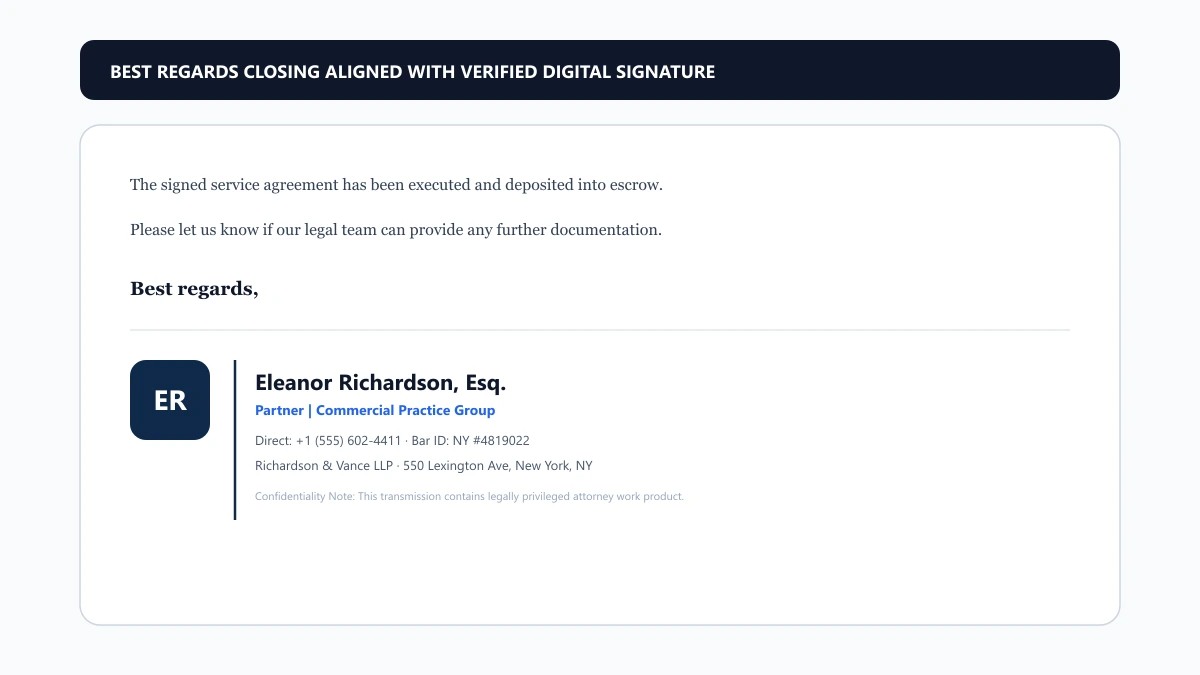
Your sign-off phrase handles the emotional tone of your exit. What follows immediately underneath—your signature block—handles the practical utility.
To ensure your job title, direct phone number, company logo, and verified social links display with crisp, professional alignment across all email clients, build your footer with our email signature generator. It guarantees that your contact details remain consistent without requiring manual styling on every email.
To explore how "Best regards" integrates into a broader closing strategy, see our complete guide on how to end an email. You can also test email subject lines and layout compliance with our free email tools.


