

When applying for a role, following up after an interview, or communicating with an executive recruiter, your sign-off must convey professionalism, respect, and attentiveness.
- Sincerely,
- *Best for:* Formal cover letters, executive applications, and initial candidate submissions.
- *Why it works:* It is the gold standard for formal career correspondence, demonstrating that you understand traditional business etiquette.
- Respectfully submitted,
- *Best for:* Submitting formal portfolios, case studies, or RFP proposals during hiring rounds.
- *Why it works:* Signals humility and diligence when delivering completed evaluation assignments.
- With appreciation for your time,
- *Best for:* Post-interview thank-you notes and scheduling follow-ups.
- *Why it works:* Acknowledges the interviewer's calendar commitment without sounding obsequious.
- Best regards,
- *Best for:* Ongoing candidate coordination with recruiters once mutual communication is active.
- *Why it works:* Clean, polished, and universally accepted across corporate recruiting.
2. Client & Account Management
Client communications require a balance of competence, approachable service, and reliable partnership.
- Best regards,
- *Best for:* Weekly status updates, monthly performance reviews, and contract discussions.
- *Why it works:* Neutral, professional, and safe across enterprise corporate cultures.
- Kind regards,
- *Best for:* Customer success check-ins, routine support answers, and friendly client check-ins.
- *Why it works:* Slightly softer and more approachable than "Best regards" while retaining full professionalism.
- Looking forward to collaborating,
- *Best for:* Kicking off new client accounts, onboarding new teams, and initial project launches.
- *Why it works:* Energetic, forward-looking, and focused directly on collaborative outcomes.
- With sincere appreciation,
- *Best for:* Renewal confirmations, annual client appreciation messages, or thanking clients for referrals.
- *Why it works:* Reinforces client value and strengthens long-term business retention.
3. Executive & Senior Leadership Communication
When writing upward to a CEO, Vice President, Board Member, or external advisor, respect their time and maintain formal deference.
- Respectfully,
- *Best for:* Formal executive proposals, board memos, and organizational policy updates.
- *Why it works:* Acknowledges institutional authority and seriousness of purpose.
- Best regards,
- *Best for:* Routine internal updates and operational answers sent to senior managers.
- *Why it works:* Professional and dignified without over-formalizing internal communication.
- With gratitude for your guidance,
- *Best for:* Writing to an executive sponsor, career mentor, or advisory board member.
- *Why it works:* Expresses genuine appreciation for leadership and mentorship.
4. First Contact & Cold Business Outreach
In cold outreach, your sign-off must avoid sounding presumptuous, overly aggressive, or prematurely intimate.
- Best regards,
- *Best for:* Enterprise B2B cold emails and partnership inquiries.
- *Why it works:* Demonstrates that you treat the recipient with professional respect from the very first interaction.
- Looking forward to your thoughts,
- *Best for:* Value-driven outreach that proposes an idea, feedback, or brief perspective.
- *Why it works:* Clarifies the requested call-to-action naturally without pressure.
- Respectfully,
- *Best for:* High-stakes outreach to academic, legal, or governmental prospects.
- *Why it works:* Sets a respectful tone that distinguishes your message from automated sales spam.
5. Delivering Bad News, Delays & Service Apologies
Delivering sensitive news—such as missed deadlines, service disruptions, or price increases—requires emotional intelligence. Never use cheerful sign-offs like "Cheers" or "Have a wonderful week!" in these situations.
- With sincere apologies,
- *Best for:* Service outages, critical project delivery delays, or acknowledged team errors.
- *Why it works:* Directly acknowledges the recipient's inconvenience and takes accountability.
- Sincerely,
- *Best for:* Formal contract terminations, price increase notices, or regulatory compliance alerts.
- *Why it works:* Dignified and serious, avoiding mismatched cheerfulness.
- Respectfully,
- *Best for:* Rejecting a proposal, declining an invitation, or contesting a billing issue.
- *Why it works:* Maintains mutual dignity even when delivering an unfavorable decision.
---
6. Expressing Gratitude & Thank-You Messages
When your email's primary function is acknowledging help, sponsorship, or extraordinary support, choose a closing that emphasizes gratitude.
- With sincere thanks,
- *Best for:* Thanking a colleague who helped you complete an urgent deliverable.
- *Why it works:* Genuine, heartfelt, and professional.
- Many thanks,
- *Best for:* Quick operational confirmations when someone provides an answer or file.
- *Why it works:* Concise, polite, and natural in fast-paced collaboration.
- Gratefully,
- *Best for:* Acknowledging significant career favors, introductions, or strategic references.
- *Why it works:* Personal, warm, and deeply respectful.
Master Reference: Professional Sign-Offs by Register
| Register | Sign-Off Phrase | Tone | Best For |
|---|---|---|---|
| Formal | Sincerely, | Dignified & traditional | Cover letters, legal matters, executive proposals |
| Formal | Respectfully, | Deferential & serious | Board members, C-level executives, judges |
| Formal | Respectfully submitted, | Diligent & formal | Submitting assignments, RFPs, official audits |
| Standard | Best regards, | Universally professional | External clients, cold outreach, corporate syncs |
| Standard | Kind regards, | Approachable & courteous | Customer support, account management, partners |
| Collaborative | Looking forward to collaborating, | Forward-looking & positive | Client onboarding, project kickoff notes |
| Empathetic | With sincere apologies, | Accountable & serious | Service outages, missed deadlines, error resolution |
| Gratitude | With sincere thanks, | Appreciative & respectful | Post-project thank-yous, mentor support notes |
Aligning Your Sign-Off with a Professional Signature
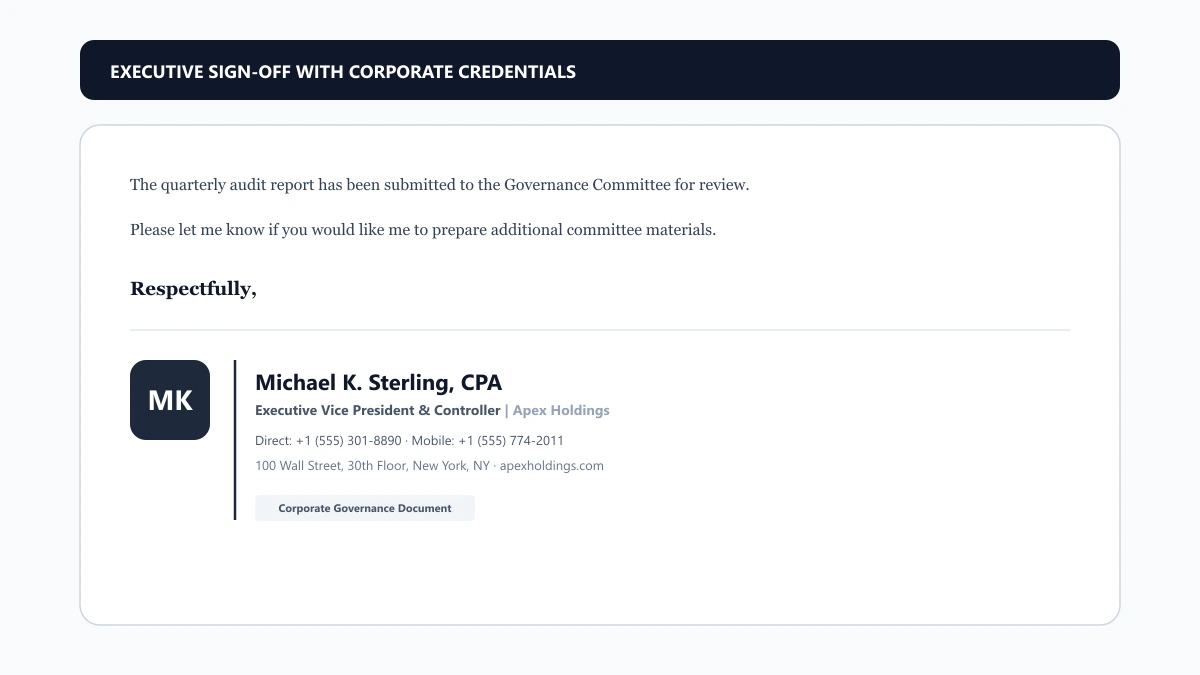
An executive-level email sign-off is only as effective as the signature block that follows it. A professional closing followed by unformatted, plain text contact details undermines your credibility.
With our free email signature generator, you can build an elegant, mobile-responsive signature that displays your title, company logo, verified phone number, and social profiles cleanly. It ensures consistent brand identity across Outlook, Gmail, Apple Mail, and mobile devices.
To see how these professional closings fit into the complete email architecture, explore our pillar guide on how to end an email and check out our deep dive on Best Regards: Meaning, Rules, Alternatives & Comparison. For tools to test subject line performance and generate email disclaimers, visit our free email tools directory.


